For most of the years I've owned my building, the rent has paid the mortgage. In the years it didn't, my share of the payment was still less than I'd have spent renting by myself. That math is why buying a two-flat was the smartest financial decision I've made, and why I could afford the building at all.
Here's how it happened.
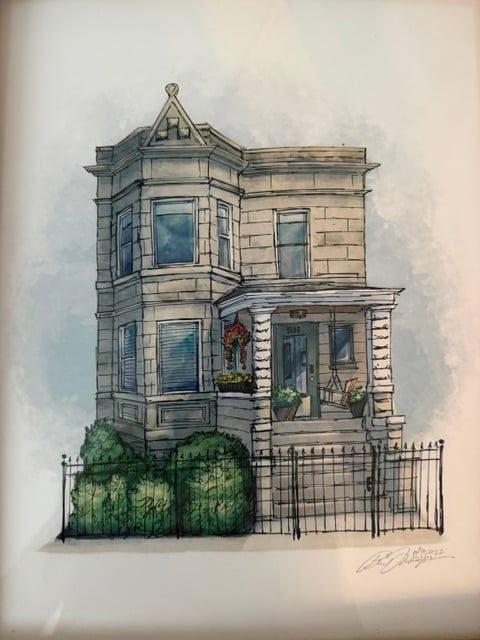
I had two criteria: I wanted to keep my housing costs low, and I wanted a greystone in Humboldt Park. Everything else was negotiable.
For a couple of years I wasn't looking that seriously. Then I was, and I started to worry I wouldn't find something I actually liked. The math was becoming clear: if I wanted a greystone and I wanted Humboldt Park, my budget wasn't going to get me into the pocket of the neighborhood I'd originally pictured myself in. The building that finally worked was on the farther west side of the neighborhood, an area I hadn't been as excited about. I went to see it anyway.
It wasn't perfect. I loved it.
The setup
The building had been recently rehabbed, but I could tell it still needed a lot of work. I got it for a very good price and I was willing to take on whatever came up. That trade, price for work, is the whole reason the deal penciled.
I was finally going to live by myself, which mattered to me. But I'd been living communally up to that point in my life and I didn't want to lose that entirely, so I built it into the building. The basement unit came with tenants who'd already been there a while. For the second floor, one of my best friends moved in. She couldn't really afford to live alone either, so we cut a deal: she'd pay lower rent, and she'd help me out with the building. Both of us got to live on our own for the first time, and I got a second set of hands.
The work
The backyard was literally a patch of dirt with glass in it. My friend and I spent that first summer getting it into shape. The garage was falling apart and had rats living in it. Eventually I replaced it with a new garage with a party door, which is exactly what it sounds like: we set the music up in the garage, open the door, and everybody dances and hangs out in the yard.
Buying a hundred-year-old building that needed work as my first purchase taught me a lot about homeownership very quickly. But I felt equipped to be that person, and I was. When I bought it, my mom said she didn't like it and couldn't really see me living there. She just didn't have the vision. The interior of my apartment turned out adorable, and over the years the projects kept happening, one at a time, when the building needed them and when I could.
Why it was the smart decision
Because the building had rental income, I could afford an asset I couldn't have touched on my own, and I could do it while charging fair rent and being equitable to the people who live there. Those two things aren't in tension. You can be a fair landlord and still come out ahead financially, because the asset itself is doing most of the work.
Here's the part first-time buyers get wrong. A lot of people assume an investment property only makes sense if it's putting hundreds of dollars in your pocket every month from day one. That was not my plan. While I lived there, I was still paying a portion of the mortgage myself, and that was fine, because my total housing cost was a fraction of what I'd have paid to live alone, and I was building equity the whole time. The wealth comes from the mortgage paydown and the appreciation, not from squeezing every dollar out of rent. I wasn't buying a paycheck. I was buying an asset that other people were helping me pay off, at rents that were fair to them. This was a personal choice - I could have gone the other route of charging market rents for income. Most people do, and there's obviously value in that too.
Here are the numbers. I bought the building in 2018 for $370,000, and it's worth about $650,000 today. There's a caveat, though: you can't buy a multi-unit in Humboldt Park at that price anymore, and I later refinanced into a 2.2% interest rate nobody is getting now, so I won't pretend you can copy my deal. But the deal isn't the strategy. The strategy is buying a building where the rent does as much of the heavy lifting on the mortgage as possible, and that math can still work today. It just looks different than it did in 2018. Living that cheaply for years is how I eventually saved enough to buy a single-family home.
The two-flat wasn't instead of my own house. It's what paid for it.
Some of the appreciation was timing, but not all of it. I bought in a neighborhood I loved at a price that made sense. I wrote about this same dynamic in Logan Square, where two-flats have been quietly building wealth for owners for decades. The same principle applies in Humboldt Park.
Owning a building like this is also not as hard as people assume. You do the inspection. You find out what you're getting into, and you decide what you're willing to get into. I highly recommend a home warranty; most of the work my building has needed was covered by mine. Not all of it, but enough that it's paid for itself several times over. Beyond that, you keep a running list of what the building needs and you handle it when you can, in the order it matters.
The people
There's a version of living in a two-flat that doesn't get talked about enough: you have your own place, fully yours, and you still have housemates if you want them. We walked each other's dogs. We had low-pressure dinners, the kind where it's just a hang and then everyone goes back to their own part of the building whenever they're ready. Someone to have coffee with in the yard. Nobody sharing your kitchen. Not everyone wants to live that way, but if you do, a two-flat is the best version of it I've found: all the company of communal living with personal space.
The original basement tenants were so nice that I was genuinely sad when they moved out a few years later. I wasn't sure I'd find people as great, but I did, and I didn't even have to work for it, which is funny, because screening tenants is literally my job. It's all been word of mouth. My friend on the second floor had her friends move into the basement, and when she moved out and bought a house of her own, they moved up into her apartment. Their friend took the basement. One of my other best friends now lives in my old first-floor unit.
That's the part of this that doesn't show up in a net proceeds sheet. The building has housed a rotating cast of people I care about for years, everyone paying fair rent, everyone staying and watching out for the building until they move on to bigger and better things.
For a long time, the plan was to stay forever. I ran the numbers on duplexing down into the garden unit, and they didn't make sense. I looked at converting the building into a single-family home, but the yard was too small, so when the city put the vacant lot next door up for sale, I tried to buy it. Because the lot was city-owned, the purchase required aldermanic approval, and for reasons I never got a straight answer on, the alderman wouldn't let me have it. If he had, I'd probably still be living there.
So I bought a house instead, and every so often someone asks if I'll sell the two-flat. I don't see why I would. It still does the same job it did on day one, and I put too much work and too much love into it to trade it for a line on a balance sheet.
FAQ
Is buying a two-flat a good first purchase in Chicago?
It was for me, and it's a strategy I recommend to buyers more than almost any other. The rental income offsets your mortgage, you qualify with owner-occupant financing, and you're building equity in an asset you couldn't afford as a single-family purchase. The trade-off is that you're a landlord from day one, so you need to be honest with yourself about whether you want that.
What's a greystone?
A classic Chicago building type, usually built between the 1890s and 1930s, with a facade of Indiana limestone. They're one of the most sought-after building styles in the city. When people say they want "character," this is usually what they mean.
How do you handle repairs on a 100-year-old building?
Get a thorough inspection before you buy so you know what you're walking into. After that, keep a running list of what the building needs, prioritize by urgency, and work through it over time. A home warranty has covered most of the major work at my building, and I recommend one, especially in your first years of ownership when a surprise repair hurts the most.
Can you charge fair rent and still make money on a two-flat?
Yes. This is the part people get wrong in both directions. The building generates wealth primarily through the mortgage paydown and appreciation, not through maximizing rent. I've kept rents fair for years and the building has still gained roughly $280,000 in value since 2018.
Should I buy a condo or a two-flat as my first home in Chicago?
It depends on what you're willing to take on. A condo is simpler: the association handles the exterior, you handle your unit, and the price of entry is lower. A two-flat costs more upfront and makes you a landlord, but the rent offsets your mortgage and you own the entire asset, land included. If you can handle the price point and the responsibility, the two-flat builds wealth faster. Mine is the reason I could eventually afford a single-family home.
How do you find good tenants?
Screening is part of my job, so I know how to do it properly: income verification, credit, landlord references. But at my own building, every tenant for years has come through word of mouth from existing tenants. If you take care of the building and treat people fairly, good tenants tend to bring you more good tenants.