Selling Your South Loop Condo: How to Plan It Right
If you're thinking about selling your South Loop condo, here's the good news: preparation matters more than timing. Most of the problems that derail condo sales don't happen at the closing table — they happen weeks earlier, in the pricing, the paperwork, or a building issue nobody investigated before going to market.
The South Loop has plenty of buyers, but it's also a neighborhood full of comparison shoppers. Someone touring your condo has probably seen several others that week — maybe a few in your own building. I list condos all over the city, and this is how I'd plan a sale if you told me you were thinking six months to a year out.
Your real competition is inside your building
In a neighborhood full of high-rises — Museum Park, Central Station, Printers Row conversions, the towers along Michigan and Indiana — the most important comps aren't "the South Loop." They're your tier. The same '01 unit four floors down that closed in March tells me more about your value than fifty sales across the neighborhood.
Within a building, value moves on things outsiders don't price correctly: floor height, the actual view (protected lake or park views versus a sightline that's one construction crane away from gone), whether parking is deeded or leased, and the monthly assessment. Two units with identical floor plans can be $40,000 apart for reasons that are completely rational once you know the stack.
One more thing about assessments: at today's interest rates, every $100 a month of HOA dues eats roughly $15,000 of a buyer's purchasing power. If your building's assessments run high for the area, your price has to acknowledge that — buyers are doing this math whether we do or not.
Your building's paperwork decides who can buy your unit
This is the part most condo sellers never think about: your buyer pool isn't just set by your unit. It's set by your association's financials.
Lenders look at owner-occupancy ratios, reserve funding, pending litigation, and any special assessments before they'll approve a loan in your building. A building with a lawsuit or thin reserves can knock out a chunk of financed buyers before they ever see your listing photos. You can't fix your association's balance sheet, but knowing where it stands before you list means we price and market for the buyer pool that actually exists.
So before we go live, I want to know: Is there a special assessment pending or recently passed? What do reserves look like? Any litigation? Does the association cap rentals (which cuts investors out of your buyer pool — or keeps them in)? Does the building have a right of first refusal, which adds days to every contract? None of these are dealbreakers. All of them are things I'd rather know in month one than week eight.
Know your building's story before the attorneys do
Once you're under contract, your attorney orders the 22.1 disclosure package — declaration and bylaws, reserve status, anticipated capital expenditures, litigation, insurance, the works. The association has 10 business days to produce it and can charge up to $375, plus $100 for rush. That part runs on the attorneys' timeline, not yours, and a good closing attorney handles it without drama.
What is your job before listing: knowing what that packet is going to say. The buyer's attorney will read it during the review period, and if there's a special assessment on the table, a thin reserve line, or a big capital project in the board minutes, I'd much rather we frame it in the pricing and marketing than have it surface as a surprise in week three. If you're on the board or get the meeting minutes, dig them out. If you're not, ask management what's planned. Closer to closing, your attorney also orders a paid assessment letter from management — separate request, separate fee, not yours to chase.
What the prep actually looks like
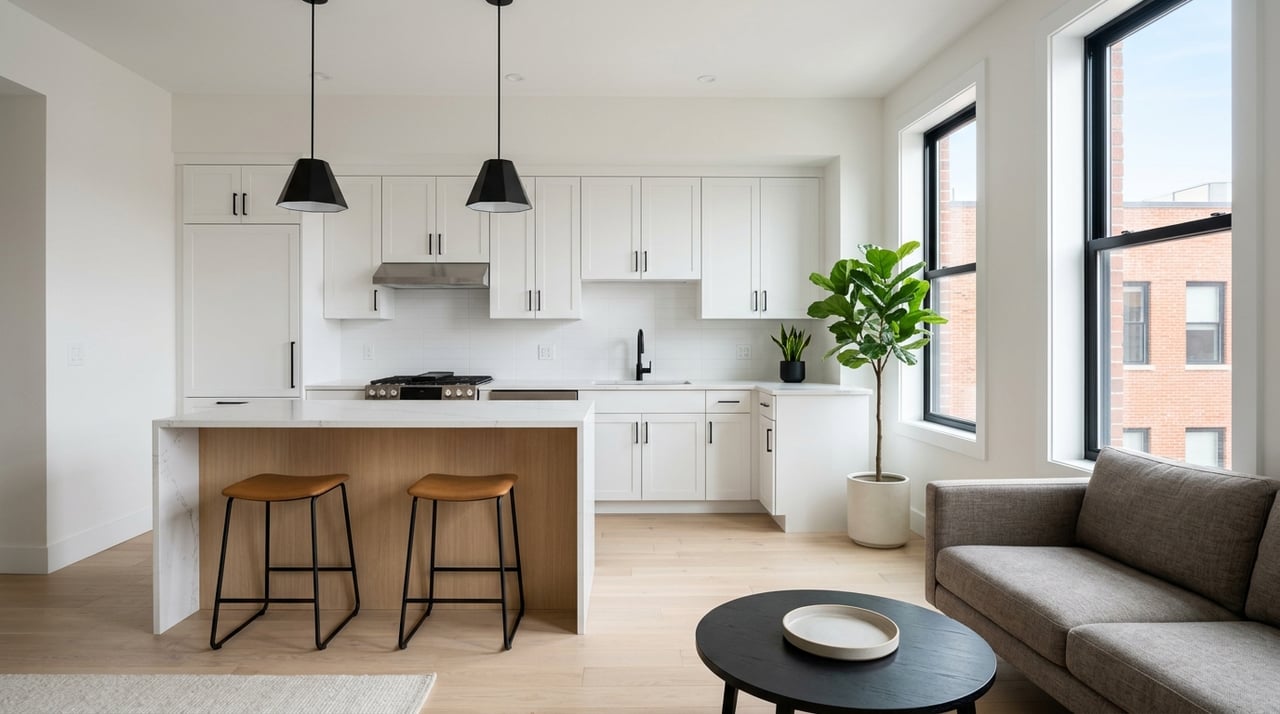
South Loop buyers scroll through a lot of near-identical floor plans. The units that stand out usually do three things: they look bright, they look uncluttered, and the photos make the layout easy to understand.
For most condos that means editing, not renovating. Remove enough furniture that the rooms feel open. Clear every countertop. Get closets to half-full so storage reads as a feature. Paint anything bold back to neutral. Deep clean the windows — in a high-rise, your windows are your biggest amenity, and dirty glass dulls a $50,000 view. If your unit has in-unit laundry, deeded parking, or private outdoor space, those go front and center in the marketing, because plenty of your competition doesn't have them.
Skip the major renovation conversation unless something is genuinely broken. In this market, a $30,000 kitchen rarely returns $30,000 at closing. A $3,000 round of paint, lighting, and staging usually returns several times that.
Know your closing costs — the real numbers
Here's where I'll save you from a common overestimate. Chicago's transfer tax gets quoted scary-high because people lump the buyer's share into the seller's. The actual split: the buyer pays $3.75 per $500 of the price. As the seller, you pay the $1.50 per $500 CTA portion, plus $0.50 per $500 to the state and $0.25 per $500 to Cook County.
On a $400,000 sale, that's $1,200 city + $400 state + $200 county — $1,800 total in transfer taxes, not the $3,600+ figure you'll see floating around. Add the 22.1 document fee, the paid assessment letter, title and attorney fees, and commission, and you have a real net number. I run a full seller net sheet for every listing before we set the price, so there are no surprises on the closing statement.
One Chicago quirk worth knowing: Cook County property taxes are billed in arrears, so at closing you'll credit the buyer for taxes covering time you owned the home. Chicago contracts customarily prorate at 105–110% of the most recent bill. It's a real line item on your net — we account for it upfront.
One thing you can cross off the list: the water certificate
If you've sold a house in Chicago, you remember the water certificate scramble — the city's signoff on the water account before transfer stamps get issued. Condo sellers get to skip it. In condo buildings, water runs through the association and is covered in your assessments, so there's no individual certificate to chase down before closing. It's one of the few ways a condo closing is genuinely simpler than a house closing — enjoy it.
A realistic timeline
If you're 6 to 18 months out, you're in the strongest possible position. Use the runway: we narrow the comp set to your building and its true peers, pull the association documents, and decide which (if any) small projects are worth doing. In the last 60–90 days before listing: declutter, paint, repair, stage, photograph. From there, contract to closing typically runs about 30 days — occasionally 45 to 60, but 30 is the norm.
Spring is the deepest buyer pool in the South Loop, but a well-prepared listing beats a well-timed one. Once we're under contract, your attorney and the title company handle the 22.1 package, paid assessment letter, transfer stamps, and prorations — while I manage the inspection and the appraisal. That's how Illinois closings work: REALTOR®, attorney, and title company, each running their own lane. In my experience, the condos that sit aren't mistimed — they're mispriced against their own building, or carrying a building issue nobody addressed upfront.
If you're thinking about selling your South Loop condo this year or next, the most useful first step is a real number: what your unit is worth against the right comps, and what you'd actually net. I'm happy to run both — reach out to Romolo Group and we'll build the plan around your timeline.
FAQs
What's the South Loop condo market like for sellers right now? Active, but selective. There's real buyer demand, but also deep inventory — you're often competing with units in your own building. Well-priced, well-presented condos move; overpriced units sit and eventually chase the market down.
Why does my building matter as much as my unit? Because lenders underwrite the building, not just the buyer. Owner-occupancy ratios, reserves, litigation, and special assessments determine which loans can close in your building — which determines who can buy your condo. Knowing your association's health before listing means no financing surprises at week six.
Who orders the 22.1 disclosure documents? Your attorney does, once you're under contract — the association then has 10 business days and can charge up to $375 (plus $100 for rush). Your job comes earlier: knowing what's going to be in that packet — reserves, planned capital projects, special assessments, any litigation — before a buyer's attorney reads it.
How much will I actually pay in transfer taxes? Less than most articles say. As the seller you pay $2.25 per $500 total — $1.50 city (CTA portion), $0.50 state, $0.25 county. That's $1,800 on a $400,000 sale. The bigger $3.75-per-$500 city portion is the buyer's, not yours.
Do I need a water certificate to sell my condo? No — that's a house thing. In condo buildings, water runs through the association and is covered in your assessments, so there's no individual water certificate to chase before closing.
Should I renovate before selling? Usually no. Major renovations rarely return their cost in this market. Paint, lighting, deep cleaning, decluttering, and staging are where the money is — they cost a few thousand dollars and change how every photo and showing reads.